All the news

Complete Spinal Cord Injury: The Trunk Controls the Stimulator

07 September 2026
Research
Complete Spinal Cord Injury: The Trunk Controls the Stimulator

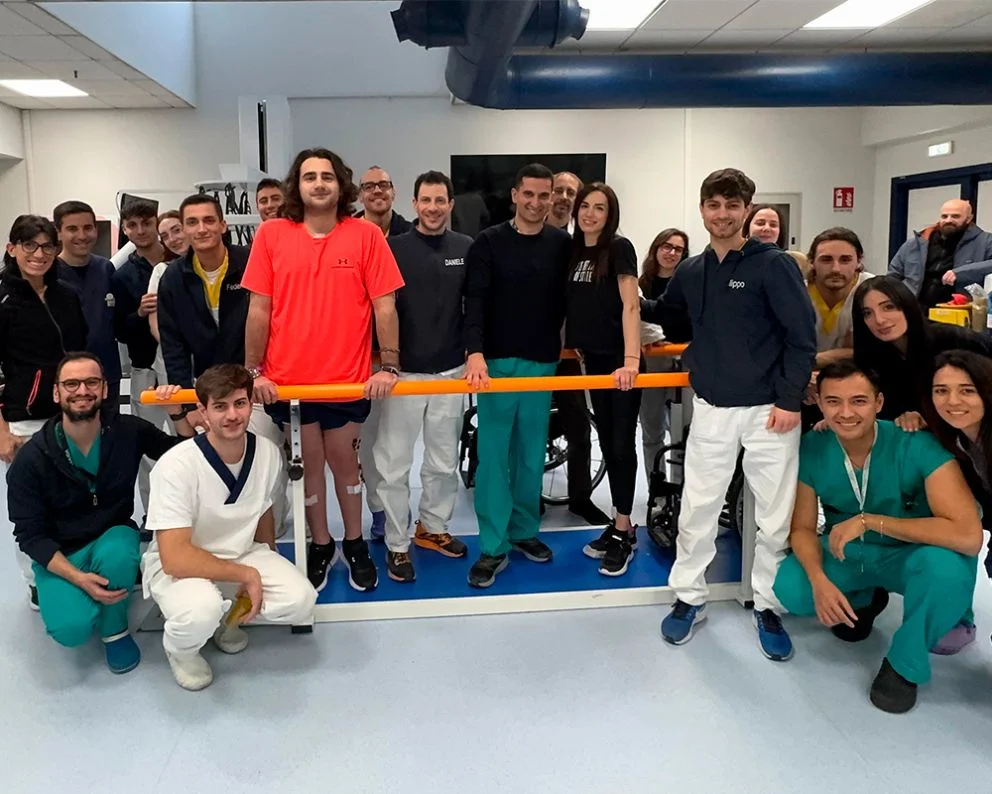
Spinal cord stimulation has allowed four people with a complete spinal cord injury to stand upright and walk again with the help of a walking frame. The new development is that these patients can control the stimulator on their own, through a small voluntary movement of the trunk that decides when the leg should move.

A study published in Med, a Cell Press journal, describes the findings. The research was carried out by the MINE laboratory (Modular Implantable Neuroprostheses), a joint initiative of Vita-Salute San Raffaele University and the Sant'Anna School of Advanced Studies in Pisa, based at IRCCS Ospedale San Raffaele. The four patients involved have a chronic thoracic spinal cord injury classified as functionally complete: none of them can voluntarily contract the muscles in their legs. The research group, led by professors Pietro Mortini and Silvestro Micera, found that once the spinal stimulator is implanted, on average, just nine degrees of trunk movement is enough for patients to regain control over leg movement.

How a Small Trunk Movement Controls the Stimulator

When active, epidural electrical stimulation of the spinal cord can trigger two opposite responses in the leg: extension, which supports the body's weight while standing, or flexion of the hip, knee and ankle, needed to advance a step. The MINE Lab researchers observed that a slight voluntary extension of the trunk is enough to switch between the two, without touching the stimulator's settings.

The team named this mechanism trunk-mediated control. Their hypothesis is that this small change in posture slightly shifts the position of the spinal cord and nerve roots relative to the electrodes, modulating the effects of neurostimulation. The body itself becomes part of the control interface. We don't need to decode a brain signal or add external sensors: we're using the interaction between a residual voluntary movement, the body's biomechanics and the stimulation of the nervous system to generate the command needed for each step,

explains Silvestro Micera, professor of Bioengineering at the Sant'Anna School of Advanced Studies. In practice, the trunk works as the command: it decides when the leg should flex, while the stimulation is what actually produces the movement.

Three Years of Research on Complete Spinal Cord Injury

The study continues a line of research that began in 2023, when the team implanted its first neurostimulator in a patient who had been unable to walk for five years because of lower-limb paralysis caused by an incomplete spinal cord injury. After the implant and rehabilitation, she regained the ability to stand and walk with a walking frame. In 2025, the group published results on two further patients, also with incomplete injuries and some residual voluntary leg movement, in whom stimulation had improved strength, motor control and walking ability.

The new study marks a shift in case selection: all four participants have functionally complete injuries, with no visible voluntary contraction of the leg muscles at the time of implantation.

Why Intensive Rehabilitation Makes the Difference

After the spinal stimulator was implanted and four months of intensive rehabilitation, all four participants were able to stand upright and walk with a walking frame, without manual assistance or body-weight support systems. The WISCI II score, the scale used to assess walking ability in people with spinal cord injury, rose from 0 to 9 for every participant. One participant covered 132 metres during 42 minutes of continuous walking, and all four handled turns, slopes and uneven outdoor surfaces. Three of the four could also stand while holding the walking frame with one hand, freeing the other for daily activities.

This result comes from combining spinal cord stimulation with an innovative rehabilitation pathway, intensive, progressive and tailored to each patient, designed to turn the motor responses triggered by stimulation into functional abilities: from standing upright to day-to-day activities on their feet, and eventually walking,

says Dr Sandro Iannaccone, Director of the Department of Rehabilitation for Neurological and Cognitive-Motor Disorders at IRCCS Ospedale San Raffaele.

Walking Without Voluntary Muscle Control

None of the four participants recovered the ability to voluntarily contract their leg muscles during the study. The legs are always moved by electrical stimulation: the trunk is the command that modulates the stimulation, and the stimulation, in turn, is the motor that produces the movement. The trunk itself does not generate the movement.

The most clinically interesting aspect is that we're not talking about a recovery of the ability to voluntarily contract the leg muscles: that ability remained absent in all four participants. What we found, instead, is a way to use a preserved voluntary function, trunk movement, to control the effects of stimulation and let the person actively take part in building each step,

clarifies Pietro Mortini, Director of the Neurosurgery and Gamma Knife Radiosurgery Unit at IRCCS Ospedale San Raffaele and full professor of Neurosurgery at Vita-Salute San Raffaele University.

Who Can Access Treatment for Complete Spinal Cord Injury Today

The four participants are part of a clinical trial studying the effects of epidural stimulation combined with locomotor training in people with chronic traumatic spinal cord injury. Enrolment for this phase of the trial has already closed, and the commercial availability of the stimulator does not mean the described treatment is readily available: it requires personalised programming and months of dedicated rehabilitation.

Anyone interested in exploring this type of treatment can book a visit with the specialists at the Neurosurgery Unit of IRCCS Ospedale San Raffaele.

The results are significant, but four participants are not enough to establish whether the principle works for everyone with a complete spinal cord injury. This first proof of feasibility will need to be confirmed in a larger group of patients.

The study was funded by Vita-Salute San Raffaele University, Boston Scientific S.p.A., Fondazione Cariplo, Fondazione Bertarelli, #NextGenerationEU and the Italian Ministry of University and Research.
Share news

You might be interested in

Wiskott-Aldrich syndrome: a new therapy corrects the genetic defect at the root of the disease
Research24 September 2026
Wiskott-Aldrich syndrome: a new therapy corrects the genetic defect at the root of the disease
JOIN4ATMP: the new video on ATMP development in Europe
The University16 September 2026
JOIN4ATMP: the new video on ATMP development in Europe
Primary CNS Lymphoma: Trial Confirms Optimal Treatment Strategy
Research15 September 2026
Primary CNS Lymphoma: Trial Confirms Optimal Treatment Strategy
IgG4-Related Disease: A UniSR-Led Study on Obexelimab
Research13 July 2026
IgG4-Related Disease: A UniSR-Led Study on Obexelimab