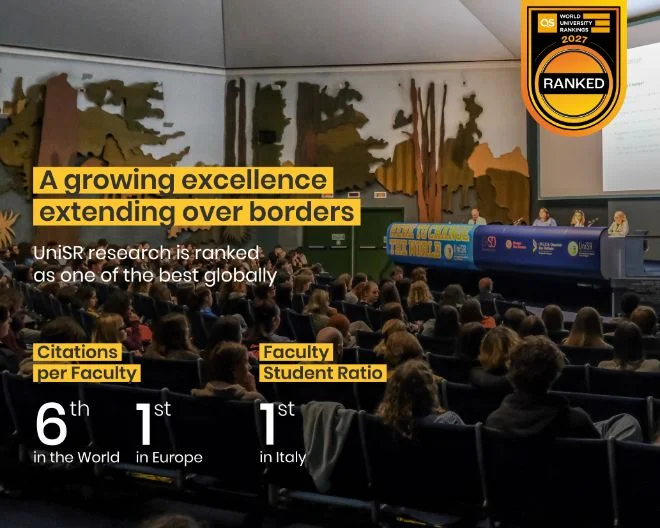
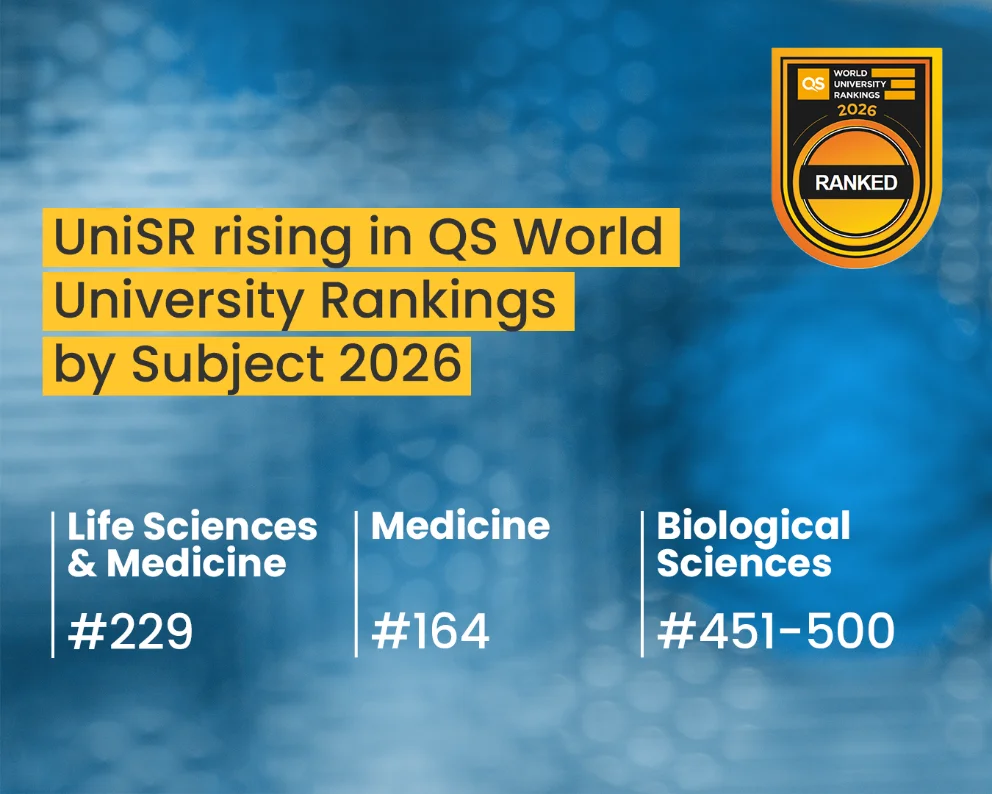
International rankings can be understood as snapshots of the state of research, teaching, reputation, internationalisation and many other aspects that are fundamental to the sustainable growth of a university with goals and values firmly rooted in the contemporary world. Against this backdrop, the results achieved by Università Vita-Salute San Raffaele in the QS World University Rankings by Subject 2026 mark a significant step forward: an improvement of 60 positions, reaching 229th place in the broad subject area of Life Sciences & Medicine; a climb of 55 positions reaching 164th place in the narrow subject of Medicine, and a further consolidation of Biological Sciences, which advances 29 positions into the 451–500 band — all in an increasingly competitive landscape, with a growing number of universities entering the rankings. Three signals that tell, in data, where UniSR is headed.
What is the QS WUR by Subject?
The QS World University Rankings by Subject is the discipline-specific edition of the broader QS World University Rankings — one of the most authoritative and widely consulted academic evaluation systems in the world. Whilst the global ranking measures the overall quality of a university, the by Subject version examines individual disciplinary areas, offering a map of excellence for those who want to understand where expertise in a specific field is truly concentrated.
The 2026 edition evaluates 6,277 institutions, of which 1,912 are ranked, across 55 disciplines organised into five broad subject areas: Arts & Humanities, Engineering & Technology, Life Sciences & Medicine, Natural Sciences, and Social Sciences & Management. The Life Sciences & Medicine area alone encompasses nine specific disciplines, including Medicine, Dentistry, Psychology, and Biology.
How the Methodology Works
The robustness of the QS WUR by Subject lies in its multidimensional methodology, which combines data on scientific output with qualitative assessments from the global academic community and the business world. Five indicators determine each university's position in the subject rankings:
Academic Reputation: based on a global survey measuring the perception of research and teaching quality within the international scientific community.
Employer Reputation: collects evaluations from employers worldwide, asking which universities produce the most capable and work-ready graduates.
Citations per Faculty: quantifies the impact of scientific publications by measuring how often a university's research output is cited in other publications, relative to the number of academic staff.
H-Index: a composite indicator that assesses both research productivity and impact, rewarding sustained quality over time.
International Research Network (IRN): measures the breadth and depth of international research collaborations. Applied to broad subject areas, it reflects a university's capacity to build global partnership networks in terms of scientific output.
The combination of these five parameters produces an evaluation that rewards not simply those who publish the most, but those who publish to the greatest effect — with higher impact, greater visibility in academic and industry circles, and well-structured international connections.
UniSR in the Broad Subject Area of Life Sciences & Medicine
It is precisely in this broad subject area that UniSR records its most significant improvement, advancing from 289th to 229th place worldwide (+60). This is not a result that comes about by chance: it is built year upon year through a body of scientific output that, in both volume and impact, places our university amongst the most recognisable names in the international biomedical landscape.
The improvement in Life Sciences & Medicine directly reflects the sustained strength of UniSR's academic reputation — that is, the way in which academics around the world perceive the quality of the work carried out in our laboratories. This perception is shaped by the quality of our publications, the frequency with which our research is cited and invited into collaborative endeavours, and the growing visibility of our results in the most prestigious international scientific journals. This solid standing combines with a significantly growing Employer Reputation and, together with our international research network, underpins the improvement in rankings.
Medicine: A Significant Climb
The most notable progress concerns Medicine, where UniSR records a significant rise in the QS by Subject rankings. This is a signal that carries a double significance: on the one hand, it confirms that the international academic reputation of our Medicine programme continues to grow, bolstered by international partnerships such as Eureka and EUHA – European University Hospital Association. On the other, it reflects a measurable increase in Employer Reputation — the indicator that captures how the global labour market values a UniSR degree.
Biotechnology: A Consolidated Position
In Biological Sciences, UniSR consolidates its presence in the QS by Subject rankings — a recognition that confirms the centrality of this field to the university's scientific identity. The three-year undergraduate degree in Biotechnology for Medical Research and its associated master's programmes are the educational expression of a research ecosystem that is unique in Italy: cutting-edge laboratories, academic staff working daily on cell therapies, genome editing and precision medicine, in close collaboration with the San Raffaele Scientific Institute.
A Research-Intensive University
The results in the QS World University Rankings by Subject 2026 form part of a broader picture of recognition for UniSR's scientific excellence. A university that does not chase rankings, but builds them on the credibility and rigour of the scientific method, day by day, study by study, collaboration by collaboration. It is the strength of our research data, the consistency of our scientific impact, and the quality of our teaching — supported by innovative approaches such as simulation — that shape this reputation, which is now reflected in the positions achieved in the world's most prestigious international rankings.
You might be interested in
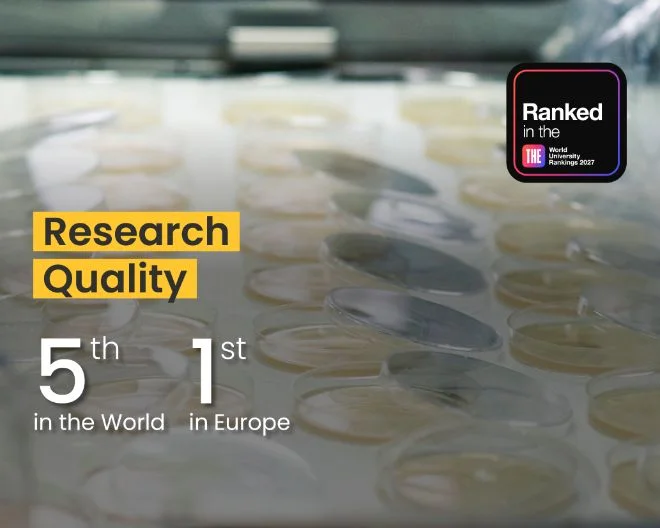
UniSR research ranks 5th worldwide
Censis University Rankings 2026/2027: UniSR ranks first in five categories

ERC Proof of Concept 2026: Boletta and Iannacone among the winners