All the news

Multiple sclerosis, breakthrough in research: researchers have identified a molecule that promotes repair of the nervous system

21 January 2026
Research

The international network coordinated by Vita-Salute San Raffaele University has achieved an important result that opens new perspectives for treating the disease

A molecule previously investigated for the treatment of sleep and wake disorders has, for the first time, shown the ability to protect neurons and promote myelin repair in experimental models of multiple sclerosis.  

The study, published today in Science Translational Medicine, identifies bavisant as a potential therapeutic candidate capable of targeting two of the most devastating mechanisms of the disease: the degeneration of nerve fibers and the failure of remyelination processes. 

The project has been led by Vita-Salute San Raffaele University and IRCCS San Raffaele Hospital in Milan (Italy). A scientific effort that has brought together the leading international centres engaged in multiple sclerosis research – including the Paris Brain Institute - Institut du Cerveau, (ICM), the University of California San Francisco, and the University Hospital Münster,– and that, starting from the exploration of a library of over 1,500 drugs, has identified a single therapeutic candidate ready for clinical development. 

The discovery marks the first major achievement of the BRAVEinMS project, the international research network established in 2017 thanks to the financial support of the International Progressive MS Alliance, of which the Italian Multiple Sclerosis Association (AISM) and its Foundation (FISM) are founding members and part of the managing board and funders. 

A disease that still has no answers

Progressive multiple sclerosis is the most severe form of the disease: it affects more than one million people worldwide and around 15,000–20,000 in Italy.  

Unlike relapsing forms, it is characterized by the continuous degeneration of nerve-fibres and the loss of myelin, the sheath that protects neurons and allows nerve signals to travel properly.  

The result is a gradual loss of motor, visual and cognitive functions, which cannot currently be halted with the available treatments. To fight this disease, over the past decades, research has focused on developing pharmacological approaches capable of simultaneously promoting myelin repair and protecting neurons.  

However, this strategy – one that could slow down or stop neurodegeneration – has not yet been achieved. 

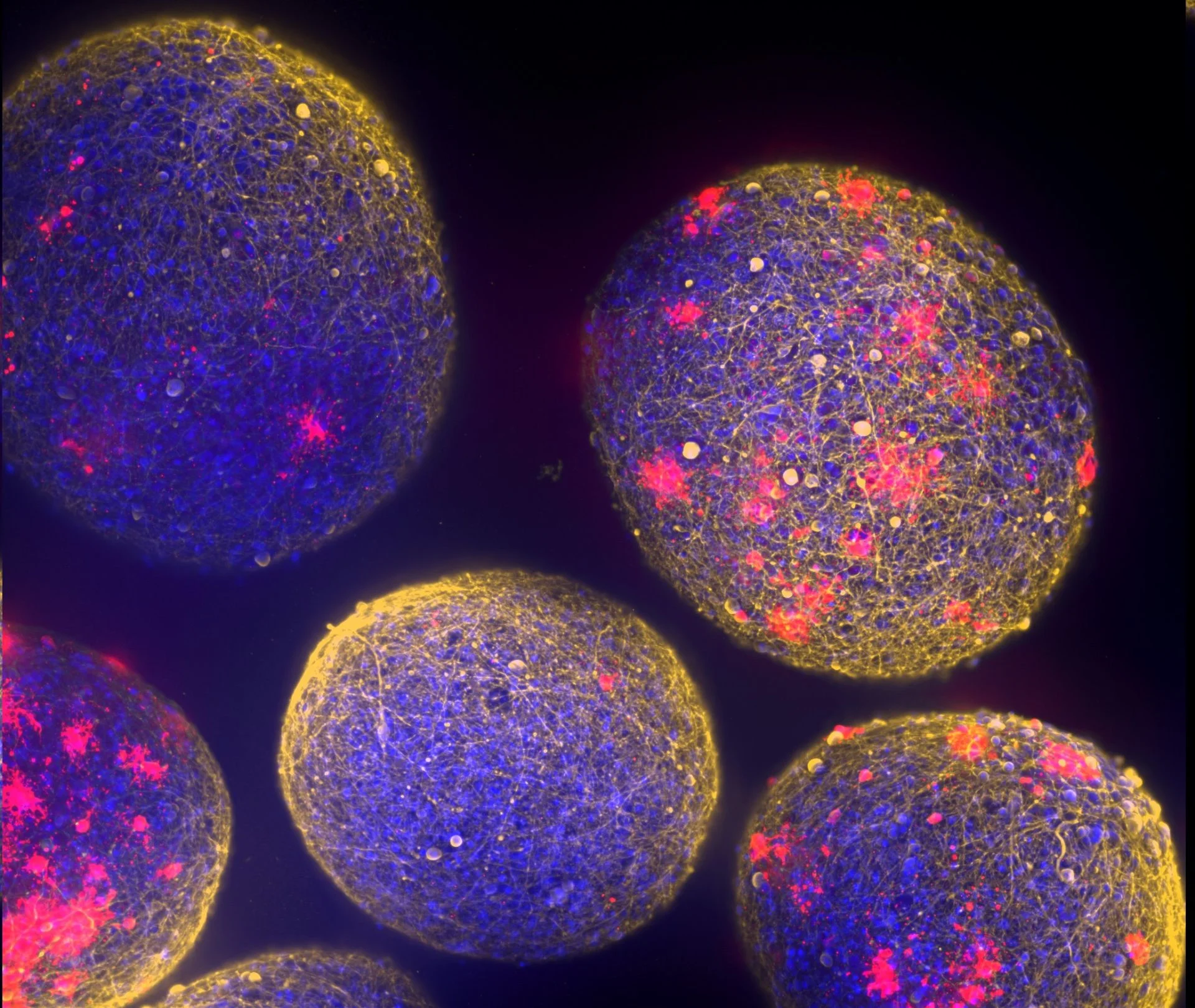
Immunofluorescence analysis of 3D brain organoids differentiated from human induced pluripotent stem cells (iPSCs), showing oligodendrocytes (red), neurons (yellow), astrocytes (green), and cell nuclei (blue). Credits: Svetlana Bezukladova and Valeria Berno, Vita-Salute San Raffaele University and IRCCS San Raffaele Hospital

From a clinical need to an innovative platform

In 2017, the BRAVEinMS consortium set out to answer an ambitious question: is it possible to repurpose drugs already approved for other therapeutic indications to treat multiple sclerosis?  

Starting from a pool of well-known drugs that have already been approved for use in humans - the so-called repurposed drugs - researchers asked what the fastest and most effective way would be to evaluate their ability to both protect and regenerate the nervous system. 

To answer this question, the researchers developed an unprecedented drug-screening pipeline combining computational analyses of large biological and pharmacological databases, human cellular models derived from patients’ stem cells, brain tissue cultures and experimental models of multiple sclerosis.  

It is like creating  a “wind tunnel” for drug testing: instead of testing one molecule at a time in a slow and costly manner, thousands of compounds can be screened and selected only if they show potential regenerative capabilities. From 1,500 molecules to a therapeutic candidate: bavisant 

The process was as rigorous as it was selective. Out of the initial 1,500 drugs, in silico computational analysis identified 273 molecules with potential activity on myelin and neurons.  

After a long series of tests to assess the toxicity of these molecules on neurons and oligodendrocytes (the cells that produce myelin in the nervous system), of both animal and human origin, the number was narrowed down to 32 compounds, and efficacy tests then reduced the leading candidates to 6.  

Ultimately, the researchers focused on bavisant, an antagonist of the histamine H3 receptor, a drug with an already well-established safety profile. 

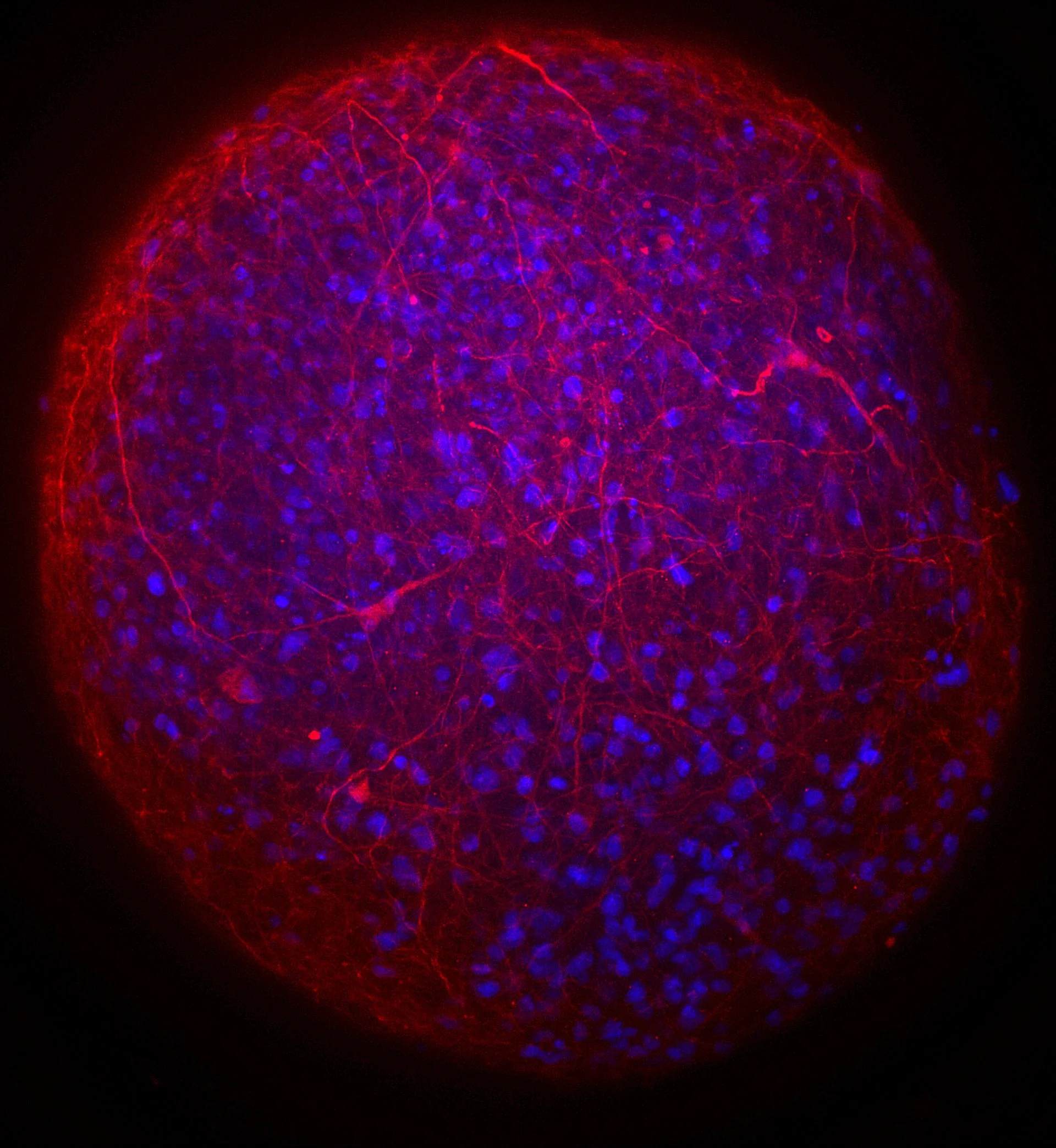
Immunofluorescence analysis of 3D brain organoids differentiated from human induced pluripotent stem cells (iPSCs) subjected to oxidative stress in the presence of bavisant. Bavisant preserves neuronal number and integrity. Credits: Svetlana Bezukladova and Valeria Berno, Vita-Salute San Raffaele University and IRCCS San Raffaele Hospital

In experimental models of multiple sclerosis, including human–mouse chimeras, bavisant has been shown to stimulate myelin-producing cells to repair nerve fibres, protect neurons from degenerative damage, and reduce the expression of genes involved in inflammation.  

Overall, the molecule acts on two different types of brain cells - neurons and myelin-producing cells - enabling nervous tissue to repair itself and withstand damage. 

A new chapter for regenerative medicine

For the first time, we have shown that it is possible to identify – through a systematic approach based on human in vitro and in vivo models – a molecule capable of regenerating myelin while at the same time protecting neurons in progressive multiple sclerosis

- explains Paola Panina, Professor of Cell and Experimental Biology at Vita-Salute San Raffaele University and senior co-author of the study.  

«This pipeline is not only designed to identify a new treatment, but also to build a new way of doing drug research: faster, more predictive, and more closely aligned with the expectations of people living with multiple sclerosis.» 

A global research

The success of BRAVEinMS is the result of an international network. 

«Through an international endeavor within the BRAVEinMS consortium, we developed an innovative drug-screening pipeline to accelerate the discovery of remyelinating and neuroprotective compounds. We identified several promising drugs that enhance myelin repair and neuroprotection in preclinical multiple sclerosis models, including bavisant, a selective histamine H3 receptor antagonist with strong potential for clinical translation. Our study marks an important step toward the development of clinical trials that target the mechanisms of neurodegeneration and disability progression in multiple sclerosis», explains Dr. Brahim Nait-Oumesmar, senior co-author and principal investigator at the Paris Brain Institute

«The integration of phenotypic in vitro assays using iPSC-derived cells as well as humanized mouse models into the screening pipeline enables the validation of the drugs candidates in human pre-clinical models and represents an important advancement», says Prof. Tanja Kuhlmann, Institute of Neuropathology, University Hospital Münster, Germany. 

«The SPOKE knowledge graph- that is, the screening pipeline- was instrumental in prioritizing drug candidates for this groundbreaking study. By integrating graph theory and machine learning, we reduced thousands of compounds to a few hundred, streamlining further testing in vitro and in vivo. This work highlights the power of computational tools in accelerating drug discovery and showcases the impact of international, multidisciplinary collaboration. Together with leading researchers across multiple institutions, we have taken a significant step toward identifying therapeutic candidates like bavisant, offering renewed hope for patients with progressive multiple sclerosis», comments Prof. Sergio Baranzini, University of California San Francisco. 

Next steps

Bavisant was not developed from scratch: it was already known.  

This means shorter timelines, lower costs and greater safety compared to developing a new molecule, an enormous advantage for a disease that affects hundreds of thousands of people and requires long-term therapies.  

The BRAVEinMS consortium is continuing to study its mechanism of action and to optimise the drug formulation, with the aim of considering the possibility of conducting efficacy studies in humans soon (i.e., phase 2 trial). 

This research was made possible thanks to financial support of the International Progressive MS Alliance, as well as contributions from the consortium’s academic and industrial partners. The International Progressive MS Alliance is an unprecedented international collaboration that brings together the world’s leading Multiple Sclerosis associations, including the Italian Multiple Sclerosis Association (AISM) and its Foundation, along with researchers, healthcare professionals, the pharmaceutical industry, companies, trusts, foundations, donors, and people living with progressive forms of multiple sclerosis.  

The Alliance was established to accelerate the development of effective treatments and to improve the quality of life of people with progressive multiple sclerosis worldwide. 

«The results of BRAVEinMS confirm that investing in strategic, shared research focused on the needs of people with progressive multiple sclerosis is a successful path. As the Italian Multiple Sclerosis Foundation, together with the other associations of the International Progressive MS Alliance, we chose to support this research model because it is capable of turning scientific collaboration into concrete opportunities for new therapies, including for those forms of the disease that have had fewer answers so far», 
says Mario Alberto Battaglia, President of FISM, and President of the International Federation of Multiple Sclerosis Associations, which brings together 80 MS associations worldwide. 

We placed a bet on an idea: combining artificial intelligence, stem cell-based modelling and collaborative science to accelerate the discovery of new therapies for progressive multiple sclerosis. Today, that bet has delivered not only a real candidate that now needs only the final stretch to reach patients’ bedsides, but also a further 30 potential new candidates that could be used in progressive multiple sclerosis. In addition, we have built and validated an effective, fully operational screening platform capable of validating and assessing the neuroprotective strength of any molecule, a platform that can become a key tool for scientific research to transform knowledge into treatments

- concludes Gianvito Martino, Vice-Rector for Research and Third Mission at Vita-Salute San Raffaele University and Scientific Director of IRCCS San Raffaele Hospital. 
Share news

You might be interested in

The microbiome as an ally against myeloma
Research04 December 2025
The microbiome as an ally against myeloma
Intrecci: a UniSR project for more inclusive and accessible cancer diagnosis
Research02 December 2025
Intrecci: a UniSR project for more inclusive and accessible cancer diagnosis
A New Approach to Enhance Immunotherapy in Multiple Myeloma
Awards11 November 2025
A New Approach to Enhance Immunotherapy in Multiple Myeloma
UniSR hosts the launch of the “Pensa all'Aorta” campaign
Research21 October 2025
UniSR hosts the launch of the “Pensa all'Aorta” campaign